
Illustrative case · Company
Incidents, minutes and reports that document themselves
A single incident channel with severity-based routing, automatic meeting minutes and a periodic report that assembles itself.
Illustrative case: a model scenario built on our method, not a specific client
- Sector
- Company
- Services
- Incident channel with SLAs
- Human oversight
- Yes, at the decision points
- Outcome
- Expected — no client metrics yet
The challenge
Operational information lived in people's heads: incidents reported by email or chat “to whoever you know”, meetings with no minutes unless someone took notes, and a monthly report that consumed days of an analyst's time.
How it was done before
Each team had its own informal alert channel; meeting decisions were reconstructed from memory; the report was put together by copying data from five different tools.
What we built
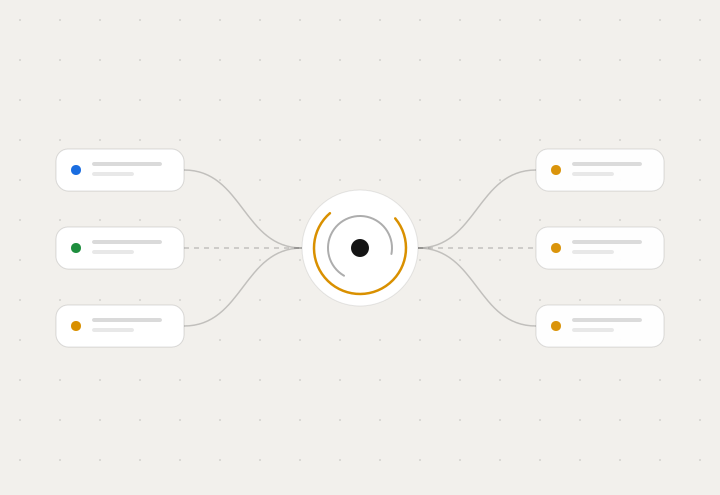
- A single channel collects incidents, classifies them by severity and routes them to the right team with a response deadline.
- Recorded meetings generate minutes with decisions and tasks, distributed to the attendees.
- The periodic report assembles itself from the data sources already connected.
- Everything leaves a trace: who received what, when, and what was decided.
Human oversight
Critical incidents escalate to the on-call person without waiting for the flow. Every set of minutes is validated by whoever ran the meeting before being filed. The report is signed off by the person in charge, who reviews the figures flagged as anomalous.
What the client takes away
- Incident channel with SLAs
- Validated automatic minutes
- Self-assembling periodic report
Outcome (expected)
The specific metrics — hours recovered, errors avoided, response times — are agreed at the start of each project and measured afterwards. This scenario is illustrative: we do not publish figures we cannot back up.
Limits
- Recording meetings requires prior internal agreement and compliance with privacy rules.
- The business decisions the report reflects are not automated.
- Rollout is phased: one team first, then the rest.
Have a similar process on your hands?
Half an hour with you is enough to know what could be automated this very week.
Book a meeting